Showing posts with label free pattern. Show all posts

Wednesday, 8 April 2015

Fun fan bookmark free pattern


I love those bookmark designs that have a motif at each end, and the centre piece is a long crochet chain that stays inside the book. The other day I wanted to whip up a quick gift for a friend  and I thought hmm, I'll make him a bookmark. So I got out some leftover yarn in bright orange and I got started. The result is this fun fan bookmark. It is incredibly quick and easy to make, I'd say it took me about 10 minutes. It was so quick and easy that I immedately made a green one too.

Here's how to make it:

Rnd 1 - 6 sc in a magic circle
Rnd 2 - 1sc, 1dc in each st around, join with ss to first stitch
Rnd 3 - ch 55
Rnd 4 - 7 dc in 3rd ch from hook, ch 3, turn
Rnd 5 - 2dc in each stitch. Fasten off, weave in ends.

And there you have a fun fan bookmark! Make lots of them and give them to your friends!

Thursday, 20 June 2013

Daisy baby afghan square


Hello there!
I so love making granny squares. I had great fun with those I finished last week for Knit-a-square. I had another delve into my stash, and came across some yarn I bought on a whim once when I was in the UK. It was so cheap, it's acrylic/polyamide (I think) but it still feels soft and cosy. The colours are a bit too pale for knit-a-square so I decided that I'd make a baby blanket either to give away or to sell.
I'd noticed cute daisy squares on some other blogs, and I decided to make my own pattern. After a few attempts I think I got it, so here it is. I've not yet finished the whole blanket, but I thought you might like to join me :-)

You will need:

DK yarn in three colours
4 mm crochet hook
a tapestry needle

It's best to finish off and sew in the ends after finishing each part (as you can see on the photo).

Rnd 1 (yellow). Make a magic circle, 3 ch (counts as first dc) and 11 dc in the magic circle (12 dc). Slst into the 3rd ch of first stitch. Fasten off, weave in ends.

Rnd 2 (white). Puff stitches make up this row. To start, pull a loop of white yarn about 1 cm long through the top of one of the dcs, *yrh and pull another loop (3 loops on hook), repeat from * three more times (9 loops on hook), yrh, pull through all nine loops, yrh, pull through remaining loop. Initial puff stitch finished. Ch 1. For the next and subsequent puff stitches, pull a loop of yarn about 1 cm long through the top of the next dc, yrh, and pull another loop through, repeat three more times, yrh, pull yarn through 8 loops on hook, yrh, pull through remaining loop. Ch 1.
Continue until the end. You should have 12 puff stitches with 1 ch space between each. At the end, make one extra ch and slst to the top of the first stitch. Fasten off and weave in ends.

It may take you a while to get all your puff stitches to the same size. The first ones I made were a bit uneven, but you soon get into the rhythm.

Now the real "granny" part begins. You'll work into the ch spaces between the puff stitches.

Rnd 3 (blue). Attach yarn between two puff stitches, 3ch (counts as first dc), 2 dc in first ch sp, ch 1, 3 dc in next ch sp, ch1, 3 dc in next ch sp, ch 2.
*3 dc followed by ch 1 in each of next 2 ch sps, 3 dc followed by 2 ch in next ch sp.
Repeat from * to end. Slst to top of beginning 3 ch. Turn.

Rnd 4 :  ch 3, in 2ch sp, work 2 dc, 2 ch, 3 dc.  *3 dc in next ch sp, repeat form * twice. Then in corner 2 ch, work 3 dc, 2ch, 3 dc.
Carry on the rnd in the same manner. When you reach the end of the rnd, sl st in top of beginning 3ch. Turn.

Rnd 5:  3 ch, in ch sp work 2 dc, then carry on the round, working 3 dc into each sp, and 3dc, 2ch, 3dc in each corner.  At the end of the rnd, slst into top of beginning 3 ch.  Fasten off and weave in ends.

And there's your daisy baby afghan square. I can't wait to see how yours work out.  I'll be back with a taa daah moment as soon as I've made enough to join them into a blanket. 

Saturday, 8 June 2013

Finger puppets and rattles

Hello there!
Well it's been a long time, again. Almost a month since my last post, naughty me.
The thing is, I've been so very, very busy. I've been busy at home, busy at work, and... busy crocheting!
Would you like to see what I've been making?
Here you are then.


Yes, finger puppets!  They're so much fun to make. Quick and easy :)  I've written up the pattern for the bear, just need to transfer it to the right computer. They're all crocheted with sportsweight yarn and a 3mm hook though you could go down to 2.5 mm. 


I've made another teddy rattle. This one's ecru and navy and has already gone to a new home!


And a ducky rattle! I followed the same pattern as the teddy rattle, adding wings and a beak. 
Here's the pattern for the wings:

Rnd 1: 6sc in a magic circle (see the teddy rattle pattern for details of the magic circle)
Rnd 2: 1 sc in next st, 2 sc in next st, around (9 sc)
Rnd 3: 1 sc in next 2 sts, 2 sc in next st, around (12 sc)
Rnd 4: 1 sc in next 3 sts, 2 sc in next st, around (15 sc)
Rnd 5-6: sc around (15 sc)
Rnd 7: 1 sc in next 3 sts, sc2tog, around (12 sc)
Rnd 8-9: sc around (12 sc)
Rnd 10: 1sc in next st, sc2tog, around (9 sc)
Fasten off.

And the beak:

Rnd 1: 6sc in a magic circle
Rnd 2: *[1sc in next 2 st, 2sc in next st] repeat from * (8 sc)
Rnd 3-4: sc around
You can add a further rnd of you want a longer beak.
Fasten off, leaving a long end for sewing.

I hope you enjoy my patterns. I would love to see your creations, please send me a link or share them on the facebook page

Thursday, 2 May 2013

May Day cushion

Hello everyone!

I hope you had a great Labour Day yesterday. Here in France it is a national holiday so I didn't go to work, but I did finish off some crochet work. And here's the result, my May Day cushion! (scroll down for the pattern).


Isn't it just lovely? It was one of those things - I bought the yarn in a sale, then saw a similar cushion on one of the blogs I read, and realised I just HAD to make a cushion with that yarn!

I didn't follow exactly the same pattern as Heather on Pink Milk, who joined her rounds with a slipstitch. I just made two simple hdc circles and crocheted them together with a shell border. Like Heather, I did use the lovely May rose from Attic24 to decorate my cushion.  My cushion is also quite big, so the central rose does look a bit small. But I love it anyway. We needed  new cushion and I think it looks particularly nice on my armchair.


Here's how I made it:

1. Start with a magic circle and 6 sc.
2. 2 hdc in each stitch.
3. *1 hdc in next st, 2 hdc in next st, rep from * to end. (it's a good idea to use a stitch marker on the first stitch throughout)
4. * 1 hdc in next 2 sts, 2 hdc in next st, rep from * to end.
5. * 1 hdc in next 3 sts, 2 hdc in next st, rep from * to end.
6. * 1 hdc in next 4 sts, 2 hdc in next st, rep from * to end.

Continue the pattern, increasing the number of single hdc in between each set of 2 hdc until you reach the required diameter for your cushion.

Then make a May rose from the cute and easy pattern by Lucy at Attic24, and sew it to the centre of one of the circles.

You can use a cushion pad you have bought or upcycled, or you could make your own. I made mine from an old sheet and filled it with polyfil. It's 40 cm across and the final row of my crochet circle has 20 hdc in between each 2 hdc. Make sure your cushion pad is washable, as the cover isn't removeable.

For the border, I did the following:

* slip stitch in first st, 5 dc in next st, slip stitch in next stitch, repeat from * to end.

Remember to put your cushion pad in place while you still have room for it! If you have a very fat cushion pad as I did, you'll have to do quite an amount of the border with the pad in situ.

To finish, sew in the ends and you're done!

Tuesday, 23 April 2013

Granny ripple Ta daaah!


Some early followers of my blog, and I mean REALLY early followers, may remember me talking about  starting this blanket ages and ages and ages ago. It's so long ago that I cannot find the original post. I've been making it on and off for well over a year. And the good news is: It's done! Finished! 
This is a really easy pattern and goes very quickly (believe it or not). The reason I took so long was that I've been sidetracked by lots of other little projects, but if I'd worked solely on the blanket it would have probably taken me three months at most. Anyway, it's now finished and has gone to its new owner. I made it with Schachenmayr nomotta Bravo yarn, it's 100% acrylic but very soft and not at all scratchy. 
I took the photo on the stairs because it was the easiest way to see the whole blanket but the blanket is single bed size. And please ignore that loose thread. I did weave it shortly after taking the pic.


Saturday, 9 March 2013

Cedric Crab


When a friend asked me to crochet him a crab for a crab-loving friend of his, I decided to have a go at designing one. After several attempts, frogging and starting again (which meant he had to wait longer than planned), I'm pleased to introduce Cedric the crab.

Cedric is a happy little chap. He can bend his claws thanks to pipe cleaners, and he peers out from beneath his African flower shell, bordered with (yes, you guessed), crab stitch!

To make Cedric, you'll need a small amount of DK yarn in two colours (more for the claws colour than for the body colour), a 3mm crochet hook, a small amount of polyfil, two 6mm safety eyes, a tiny strand of black embroidery thread (for the mouth), and a blunt tapestry needle or bodkin.

As I mention in most of my patterns, I have chosen to enclose the polyfil in a piece of old tights.

However, the construction of the crab means that if you crochet tightly, you may not need to do this. There are holes in the African flower, but the crab body is closed up beneath the flower so you may be able to get away with not lining.

Please note that because of the pipe cleaners in the legs, this toy is not suitable for very young children. You can stuff the legs instead of using pipe cleaners, but this will not obtain the same result. And if you want to offer it to young children, you may prefer to replace the safety eyes with embroidered eyes.

You are welcome to sell any crabs you make, but please do not sell this pattern. Do not post this pattern to any website, but link directly to my blog. No file sharing of this pattern. Please respect my designer rights.

Special thanks to Heidi Bears for her tutorial for the African flower pattern, which is an integral part of this design. And thanks to Tamara Kelly for her video explanation of the crab stitch. You'll find links at the relevant points in the pattern below.

If you make a crab using this pattern, it would be great to see it on our flickr page, or share it on the Is it a toy crochet Facebook page. Likes, shares and comments guaranteed!

I shall refer to red yarn and yellow yarn as those are the colours I chose and that correspond to the photo. The crab would look great in other colour combinations too.

Finally, there may still be some errors or incongruences in the pattern. If you have any questions, tips or comments, please post them below.


The ten legs/claws are the longest part of this pattern, so I suggest you start with those. The rest is plain sailing.

If you want to stuff the legs, do so as you go along. If you choose to use pipe cleaners, that's explained below.

Big claws (make 2)

With red

Rnd 1 - Start with a magic circle and 6 sc (for a tutorial on how to make a magic circle, see this video http://www.youtube.com/watch?v=WLuSVyKvoUg)

Rnd 2-3 - Sc around (6 sts)

Rnd 4 - [2sc in next st, 1sc in next st] three times (9 sts)

Rnd 5 - [1sc in next 2 sts, 2sc in next st] three times (12 sts)

Rnd 6-8 - sc around (12 sts)

Rnd 9 - [1sc in next st, sc2tog] three times (9 sts)

Rnd 10 - In back loops only:  [1sc in next st, sc2tog] three times (6 sts)

Rnd 11 - In both loops: [2sc in next st, 1sc in next st] three times (9 sts)

Rnd 12-14 - sc around (9 sts)

Rnd 15 - [1sc in next st, sc2tog] three times (6 sts)

Rnd 16 - sc around (6 sts)

Rnd 17 - [2sc in next st, 1sc in next st] three times (9 sts)

Rnd 18-19 - sc around (9 sts)


Now make the "thumb"

With red

Rnd 1 -  Start with a magic circle and 6 sc

Rnd 2-3 - sc around (6 sts)

Rnd 4 - [2sc in next st, 1sc in next st] three times (9 sts)

Rnd 5 - sc around

Rnd 6 - [1sc in next st, sc2tog] three times (6 sts)

Finish off, leaving a tail of yarn for sewing. Press sides together and sew through both layers and on to three of the visible loops on Rnd 10.


Back legs (make 6)

With red

Rnd 1 -  Start with a magic circle and 6 sc

Rnd 2-3 - Sc around (6 sts)

Rnd 4 - [2sc in next st, 1sc in next st] three times (9 sts)

Rnd 5 - sc around (9 sts)

Rnd 6 - [1sc in next st, sc2tog] three times (6 sts)

Rnd 7-8 - sc around (6 sts)

Rnd 9 - [2sc in next st, 1sc in next st] three times (9 sts)

Rnd 10-11 - sc around (9 sts)

Rnd 12 -  [1sc in next st, sc2tog] three times (6 sts)

Rnd 13-15 - sc around (6sts)

Finish off, leaving a long tail of yarn for sewing


For each leg, fold a pipe cleaner in two and enter the folded end into the leg, pushing it to the tip. Trim the ends, folding them back into the leg to avoid pointed ends sticking out.  You don't need to put pipe cleaners into the very back legs:


Very back legs (make 2)

With red

Rnd 1 -  Start with a magic circle and 6 sc

Rnd 2-3 - Sc around (6 sts)

Rnd 4 - [2sc in next st, 1sc in next st] three times (9 sts)

Rnd 5 - [1sc in next st, sc2tog] three times (6 sts)

Rnd 6-11 - sc around (6 sts)

Finish off, leaving a long tail of yarn for sewing


Body (make 1)

With yellow

Rnd 1 -  Start with a magic circle and 6 sc

Rnd 2 - 2sc in each st around (12 sts)

Rnd 3 - [2sc in next st, 1 sc in next st] rep around (18 sts)

Rnd 4 - [2sc in next st, 1sc in each of next st 2st] rep around (24 sts)

Rnd 5 - [2sc in next st, 1sc in each of next st 3st] rep around (30 sts)

Rnd 6 - [2sc in next st, 1sc in each of next st 4st] rep around (36 sts)

Rnd 7 - [2sc in next st, 1sc in each of next st 5st] rep around (42 sts)

Rnd 8 - [2sc in next st, 1sc in each of next st 6st] rep around (48 sts)

Rnd 9 - In back loop only: sc around (48 sts)

Rnd 10-12 - In both loops: sc around (48 sts)

Rnd 13 - In back loop only: [sc in each of next 6st, sc2tog] rep around (42 sts)

Rnd 14 - [sc in each of next 5st, sc2tog] rep around (36 sts)

Rnd 15 - [sc in each of next 4st, sc2tog] rep around (30 sts)

Attach the safety eyes betwee row 11 and 12. Embroider mouth between rows 9 and 10.

Sew on the legs, starting with the big claws, placing each one about 1 cm from the face. Continue to sew the legs on, one on each side at a time, keeping them as symmetrical as you can.

Place stuffing pillow (made from 2 round pieces cut out from a pair of old tights, sewn together, stuffed and close up the hole) or start stuffing.

Rnd 16 - [sc in each of next 3st, sc2tog] rep around (24 sts)

Rnd 17 - [sc in each of next 2st, sc2tog] rep around (18 sts)

Finish stuffing.

Rnd 18 - [sc in next st, sc2tog] rep around (12 sts)

Rnd 19 - sc2tog to end (6 sts)

Sew the hole closed, fasten off and bury the end of yarn inside the body.


African flower shell

Make a two-tone African Flower. You can follow Heidi Bears' tutorial here, but please note that it is slightly different towards the end, so check the round-by-round instructions below too.

http://heidibearscreative.blogspot.fr/2010/05/african-flower-hexagon-crochet-tutorial.html

Some of these instructions are copied from Heidi Bear's website, with her permission.

Rnd 1 - With yellow - Make a magic circle. Ch 3, 1 dc, 1ch. [2dc 1ch] five more times, so you end up with six 2dc groups, separated by a ch. Make 1 final ch and sl st into the 3rd ch of the initial 3 ch. Cut yarn

Rnd 2 - With red - Insert hook into the space just to the right of the 3ch leg from the previous round. Yarn around hook, pull yarn through, ch3 (counts as 1dc).  1dc into the same space, ch 1 and make 2dc into the same space again.

Work the same 2dc, ch1, 2dc into each ch sp around. You will have six groups. Sl st to the 3rd chain to finish the round

Rnd 3 - With red - Insert your hook into the space created by the chain stitch between the 2dcs. Ch 3 (counts as 1dc)
Make 6 further dc into the same space. There should be 7 dc. Continue with 7dc in each ch sp. You will have six 7dc groups. Sl st into top of 3ch.

Cut yarn, join yellow.

Rnd 4 - with yellow - 1 sc into each of next 7 sts. Now work a long dc into the space just above the
yellow "petal" of Rnd 1. Look at Heidi Bear's tutorial for guidance :)

Continue to work you way around the hexagon...7sc, dc, 7sc, dc etc, until you get back to the beginning...as always, join the round by slip stitch into the first sc.

Cut yarn, join red.

Rnd 5 - with red - Working in front loop only. Sc around, but working 2sc in the fourth stitch at the centre of each "petal".

(In rnd 5 I may have used hdc rather than sc, but sc will make a smaller shell, which may look better. Please feel free to experiment!)

Rnd 6 - with red - crab stitch around (see Tamara's great video explaining how to do crab stitch, here: http://www.mooglyblog.com/reverse-single-crochet-crab-stitch/)

Fasten off and weave in the last yarn end. The others can be simply trimmed as they will not be visible when the crab is completed.

Now, using the two visible lines of stiches made which stitching into front stitch or back stitch only, sew the shell onto the crab's body. And you're done!

Wednesday, 23 January 2013

Birdie decoration


I've not been feeling very well for the last 10 days or so, and I really needed some instant gratification. I had lots of scraps of cotton yarn and decided to have a go at the birdie decoration from Lucy's Attic24 tutorial. I love it!  I didn't follow the pattern exactly, for example I used dc instead of hdc, and my cotton yarn was a lot finer than the yarn Lucy used for her bird. But the general idea is the same. It was a fun project and I would advise it if you want a quick, cute, easy project.


Friday, 21 December 2012

Some recent projects and...

Hi there dear reader,
I hope you are well and happy and not suffering too much from the cold weather that we're having right here in the Northern hemisphere.  Where I am it is damp, damp and more damp. And grey. I'm really missing the South African warmth and vibrant colours. But I suppose that's life.

To cheer myself up, I've been very actively Finishing Things Off. Or trying to. Here's the results:


First of all, a lovely little sausage-dog for a friend's baby. I used Debbie Bliss Eco Baby yarn and a 3 mm hook. The pattern is not one of my own this time - I used this pattern from Premier Yarns. The pattern was straightforward but if I'd have one criticism it would be the sewing together! The pattern has nine pieces that need to be sewn together which may be all right if you like sewing, but I don't... Sewing the head to the body was particularly difficult as it is means sewing two rounded shapes together, and even after all possible efforts the head was still a bit wobbly.  But the parents liked it and I think the baby did too.


Secondly, this rather short scarf for a friend. It's such a pity that the photo doesn't really reflect how light and soft this yarn is. It's Faerytale by Du Store Alpakka - a beautifully lightweight and incredily soft brushed Alpaca wool. I only had one 50g ball, but still decided to make this little wrap. I used a free pattern I found on  Ravelry called Airy Shells Scarf. It's an easy pattern and perfect for this kind of yarn.

And today's last project is...


A little fox brooch!  This little guy was easy but a bit fiddly to make out of felt. You need really sharp scissors to cut out the tiny pieces. I'll draw out the pattern pieces and post this up on the blog soon, if you'd like it.

Oh and I've made a promise on my facebook page that there will be a giveaway soon. I'm just waiting to get to 200 followers on the blog (there are already well over 100 likers on facebook) and I'm putting together a little selection of bits and bobs to cheer up a happy winner. More about that very soon!


Thursday, 25 October 2012

Teddy rattle free pattern


Thank you so much for your interest in my little teddy rattle. Here, at last, is the pattern.

As usual, please do not sell this pattern. Do not post this pattern to any website, but link directly to my blog. No file sharing of this pattern. Please respect my rights as the designer of this pattern, so that I can keep on sharing my patterns for free.

(A word on lining: I line the head with cotton fabric so as to be sure that none of the polyfill will come out. I consider this is especially important when making toys for babies. If you want to do the same, when you get to row 18 of the head, draw around it on a piece of paper and use this as a pattern to cut out two pieces of soft cotton fabric. stitch close to the edge, leaving a gap for stuffing that is also big enough for the rattle insert. Now turn inside out and place it inside the head. Now stuff it and add the rattle insert, sewing it closed by hand.)

For this photo, I stuffed the cotton "bag" before putting it in the head. It's easier to place the empty "bag" in the head before adding the rattle and stuffing it, and then sew the gap closed.


Another solution would be to user a smaller hook, so that your stitches are really very tight. I prefer to line.

For now, though, let's get on with the actual pattern.

(Please note that the pattern has not been properly tested, so there might be some mistakes. If you find any, or if any of it is difficult to understand, please tell me in the comments section and I will update/respond to the best of my ability.)


You will need:

A small amount of sportsweight yarn in two colours (I used Debbie Bliss eco baby)
Contrasting yarn or embroidery thread for the face
A 3 mm crochet hook
A rattle insert
Stuffing

Start with the ears (make 2)

Using colour A make a magic ring

rnd 1 - 6 sc into magic ring
rnd 2 - 2 sc in each st around (12 sts)
rnd 3-4 - sc around (12 sts)
rnd 5 - [sc2tog, 1 sc], rep to end (8 sts)
rnd 6 - working through both thicknesses, 4 sc.

Fasten off, leaving a long tail to sew the ears to the head.


Now make the little arms (make 2)

Using colour B make a magic ring

rnd 1 - 6 sc into magic ring
rnd 2 - [1 sc in next 2 sts, 2 sc in next st] twice (8 sts)
rnd 3 - sc around (8 sts)
Change to colour A
rnd 4-10 sc around (8 sts)

Fasten off.


Head 

Using colour A make a magic ring

rnd 1 - 6 sc into magic ring
rnd 2 - 2 sc in each st around (12 sts)
rnd 3 - [2 sc in next st, 1 sc] rep around (18 sts)
rnd 4 - [2 sc in next st, 2 sc] rep around (24 sts)
rnd 5 - [2 sc in next st, 3 sc] rep around (30 sts)
rnd 6 - [2 sc in next st, 4 sc] rep around (36 sts)
rnd 7-9 - sc around (36 sts)
rnd 10 - [2 sc in next st] three times, sc in next 15 sts, [2 sc in next st] 3 times, sc in next 15 sts (42 sts)
rnd 11-13 - sc around (42 sts)
Carry on sc to just below the middle inc stitch of row 10. (If you look carefully, you'll notice that the increases of rnd 10 are visible as three larger stitches on each side of the head. Use those stitches as a guide of where the sides of the head are) Change to colour B.  (see photo)

Can you see the larger stitches?


rnd 14-16 - sc around (42 sts)

rnd 17 - [1sc in next 5 sts, sc2tog] rep around (36 sts)
rnd 18 - sc around (36 sts)

Now is a good time to sew on the ears and embroider the eyes, nose and mouth with contrasting yarn or embroidery thread. To place them, flatten the face, making sure that the increases of rnd 9 are on the edge of the head, giving it the right shape.  Sew the ears on between rows 4 and 7. Embroider the nose in the middle of the face, on rnd 12. Space the eyes evenly in relation to the nose, then add the cheeky smile. Now stuff the head. (See notes above re lining the head before stuffing)

rnd 19 - [1sc in next 4 sts, sc2tog] rep around (30 sts)
rnd 20 - sc around (30 sts)

rnd 21 - [1sc in next 3 sts, sc2tog] rep around (24 sts)
Change to colour A
rnd 22 - sc around (24 sts)

Join in one of the arms by crocheting through both thicknesses together with the rest of rnd 23.

Continue sc until you are at the centre front of the head, then skip 12 sts and sc in the next st. From now on, you will be working only in the remaining 12 sts. Work several rows in colour A, and then add colour B and work in a spiral, changing colour every 12 sts (leaving the yarn to one side every time you change colour - don't cut the yarn!) If you prefer, you can also make the handle in a single colour.

Here you can see how the handle is constructed.

Continue the tube, stuffing as you go. As this part is too narrow to line, I use a very old woollen felted blanket, cut into little shreds, to stuff the handle. Continue until the handle measures approx 19 cm (7 1/2 inches), finishing with colour A, and work the same number of rounds in colour as you did at the beginning of the handle. Join in the second arm, on the same side as the first one (see photo). Finish off the rnd on the opposite side to the arm and finish off, leaving a long thread for sewing.


Now make sure you have stuffed the handle enough, then very carefully sew the open part of the handle to the remaining 12 sts of the head.

Don't hesitate pulling on it to make sure your stitches are strong enough. Safety is an issue here! When you're satisfied that the handle is securely sewn, fasten off and hide the ends inside the head.

And there you have a cute little teddy rattle!

Saturday, 25 August 2012

Sammy snake finger puppet free pattern


I've made this little finger puppet several times, so decided to (at last!) write up the pattern and share it here.

For this, and all of my patterns, please respect my designer rights and do not claim this pattern as your own. You are free to use the pattern to make, give and sell toys but please credit me as the designer. If you want to share this pattern, please do not reproduce it on your site, but link back to  http://isitatoy.blogspot.fr/2012/07/sammy-snake-finger-puppet-free-pattern.html. Thank you!

This is the IDEAL last-minute little gift for the small children in your life. It is really quick and easy to make with a tiny amount of yarn, and kids love it! I've offered it to all ages from three to seven, and they all had great fun with their little snake. It works best with worsted/aran yarn, though I've also used DK with success.  The DK yarn makes a smaller snake, but it still fits tiny fingers. The eyes are embroidered, and for the tongue you can either choose the easy option, as I did, just by pulling through the tail of yarn, from the wrong side, or you can use felt, and if you're feeling adventurous, you can crochet a tongue  using embroidery thread. The pattern for the tongue is down below, at the botton of this post. Have fun, ssssssssssss.

You will need:

A small amount of yarn
A crochet hook that corresponds to your yarn (I used a 4mm hook with aran, or a 3.5mm hook with DK)
Embroidery thread for the eyes
(optional) Red or pink felt or embroidery thread for the tongue

The pattern for the crochet tongue can be found below the main pattern.

Row 1 - make a magic circle with 5sc
Row 2 - 2sc in each st (10)
Row 3 - sc around (10)
Row 4 - [1sc in next st, 2sc in next st], continue around (15)
Row 5 - [1sc in next st, 2sctog], continue around (10)
Row 6 - sc around (10)
Row 7- [1sc in next 3 sts, sc2tog] twice (8)
Row 8-10 - turn. sc in same st, sc in next 5sts (6)
Row 10 - turn, sc in 6 sts, 2ch
Now you continute to work in rounds again.

Row 11 - 1sc in 6sts, 2sc in 2 ch sp
Row 12-13 - 1 sc around (8)
Row 14 - sc2tog, sc to end (7)
Row 14-15 - sc around (7)
Row 16 - 1sc in 5 sts, sc2tog (6)
Row 17-19 - sc around (6)
Row 20 - sc2tog x 3
Fasten off and pull end to the inside of the snake, trim ends.

Embroider the eyes, then make the tongue by pulling the beginning thread through to the right side and trimming it to tongue size. Or by cutting out a piece of felt, pulling the end through the middle of the magic ring, and sewing securely in place. Otherwise, you can make a tongue from embroidery thread, as follows:


Snake tongue


You will need:

Red or pink embroidery thread (or another colour if you feel like it)
a small crochet hook (I used a 1.75mm hook)

ch 9
1 ss in 2nd ch from hook, 1 ss in next 2 ch
ch 4
1 ss in 2nd ch from hook, ss to end. Fasten off and knot the ends. Pull the end through the middle of the magic ring, and sewing securly in place.

Please let me know if you find any mistakes in the pattern, or if anything is not clear and I will make corrections. If you make any cute snakes, feel free to share them on our flickr group.


Friday, 29 June 2012

Topknot stripes baby hat


Hello there!

Here's a new pattern for you - a cute baby hat with a knot in the top. It exists in two sizes - 0-3 months and 3-6 months, and in two different categories of yarn, dk and worsted.

Here's the pattern in the first size and in dk yarn, instructions for alternative size and yarn can be found at the end of the pattern.


You will need:

  • Small amount of yarn in two colours. I used Rowan by Amy Butler belle organic dk (cotton/wool)
  • 3.5 mm crochet hook
  • 4 mm crochet hook

This pattern uses US crochet terms hdc and dc. In English terms these are half treble and treble.

Gauge for dk:  4 dc and 2.5 rows per inch with 4 mm hook
4 dc and 3 rows per 3cm with 4 mm hook.

The hat is crocheted from the top down.

You'll need to know how to make a magic circle (see this video)

Do not cut off the yarn between rows but leave the yarn in the INSIDE of the hat and pick up the new colour for each alternate row. 

How to change colour:
Finish off each row with a slip stitch. Then pull through a loop of the other colour (B), and pull the thread of colour A to tighten it and make it (practically) invisible below colour B. Work three ch at the beginning of the new row with colour B, and continue crocheting around. 

You will work the odd rows in colour A and the even rows in colour B

Row 1 - With Colour A and 3.5 mm hook make a magic circle and work 8 hdc into it. Join with ss to the first stitch.

Row 2 - Join Colour B, work 3 ch, 1 dc in base of the 3 ch, then 1 dc in each st around. (9 sts)

Row 3 - Join Colour A, work 3 ch, then 1 dc in each st around. (9 sts)

Rows 4-19 - Continue in pattern

Row 20 - 3 ch, [2dc in next st, 1 dc in next 2 sts] to end (13 sts)

Row 21 - 3 ch,  [2 dc in next st, 1 dc in next 5 sts] to end (15 sts)

Row 22 - 3 ch, [2 dc in next st, 1 dc in next 2 sts] to end (20 sts)

Row 23 -  same as row 22 (27 sts)

Row 24 - 3ch, [2dc in next st, 1 dc in next st] to end (40 sts)

Row 25 - change to 4mm hook and work 1 dc in each st around (40 sts)

Row 26 - 3ch, [2dc in next st, 1 dc in next 5 sts] to end (47 sts)

Row 27 - 3ch, [2dc in next st, 1 dc in next 6 sts] to end (1 dc in last 3 sts) (53 sts)

Row 28 - 3ch, [2dc in next st, 1 dc in next 7 sts] to end (1 dc in last 4 sts) (61 sts)

Rows 29-32 - 1 dc in each st around

Row 33 - 1 hdc in each st around, fasten off.

Now fasten a loose knot in the top of your hat and you're done!

Using worsted weight yarn:


Gauge for worsted: 4 dc and 2 rows per inch with 4 mm hook
5 dc and 2.5 rows per 3 cm with 4mm hook


To make the 0-3 months size, follow the pattern down to row 26. Then from row 27 onwards, do not do any more shaping. Work 6 rows in straight dc, then finish with a row of hdc.

To make 3-6 months size, follow the pattern down to row 32. Then work two more rows in straight dc, and finish with a row of hdc.


I hope you enjoy making these little hats. If you have any questions or comments, please tell me and I promise to respond.

As usual, please do not sell this pattern. Do not post this pattern to any website, but link directly to my blog. No file sharing of this pattern.

Friday, 11 May 2012

François l'éléphant


Hello there!

A week from today I'll be going on holiday to see family and friends in England. Yay! I'm really looking forward to it. Before I leave, I'm trying to finish off as many Unfinished Projects as possible. This little elephant had been sitting in a bag in my room for several months, and to be honest I didn't really like how it was looking. I was even tempted to throw it out. But yesterday I came across it again and decided to finish it off. I'm so glad I did! I found the pattern on Ravelry, but you can also find it here. 

Why François l'éléphant, I hear you asking, Because when I finished off this little guy, for some strange reason he reminded me of the new French President, There's something in his expression. François l'éléphant président.

Wednesday, 9 May 2012

Little pink owl


Hello there!
I've been making owls again. This time it's a cute tiny pink one! I haven't found a name for her yet, but I have a feeling that she'll soon be adopted. She's only tiny, 2 inches or 5 cm tall and wide. I made her with a lovely shiny crochet thread that I've had for ages and ages, and a 1.75 mm hook. Her goggly eyes mean she can have different expressions and look even cuter. And did I mention that she's cute?

I've also make a lovely little flower pin, using the pattern from Yellow, Pink and Sparkly, a lovely blog that I follow and where you can find some great free patterns. I've only made one for now. Here it is:


I'm also busy finishing off a whole variety of hats, but more of that next time, maybe.

Bye for now!

Monday, 9 April 2012

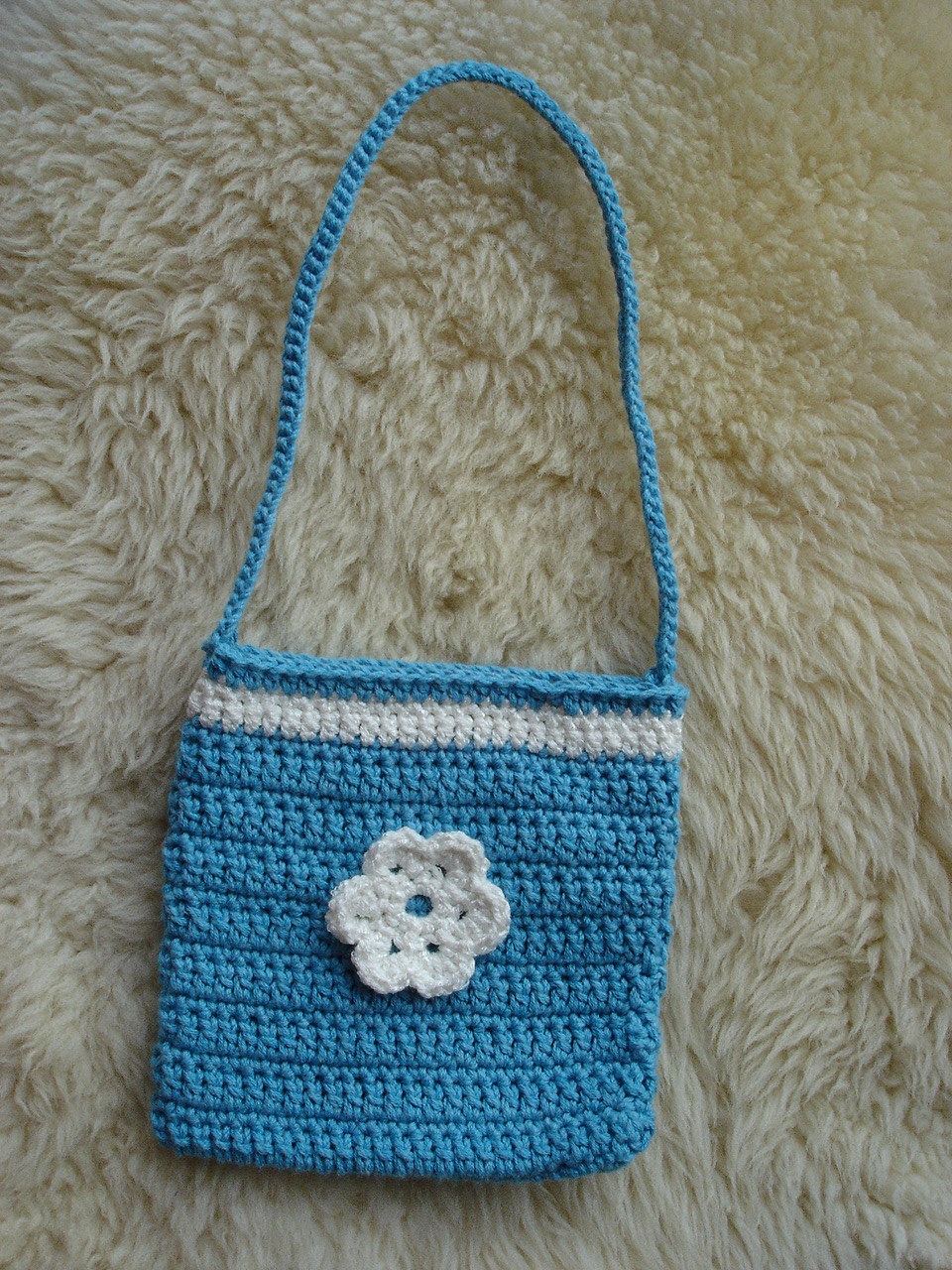
Chloe's bag a free pattern


Here's a very simple pattern to make a little bag for a little person. This one is a gift for Chloe, aged 18 months and who is very fond of bags. If you make the handle longer it would also suit for someone rather bigger. You might want to line it and add a zipper, but I'm just offering the basic pattern, then it's up to you to make any changes.You could embellish it with buttons and beads, I'm sure you have lots of ideas. I'd love to see what you come up with!

The bag is made in one piece, with the handle crocheted in so there's no sewing involved. I used aran type yarn and a 4 mm hook, and the bag is 14cm wide and 15cm high, but it's a very adaptable pattern so you can choose the yarn and hook of your choice. Just alter the number of starting chain stiches and the number of rows to obtain the size you want.

Chloe's bag

With main colour, ch 25

Rnd 1 - 1 sc in third ch from hook, 1 sc in each ch, and 3sc in last ch, then sc back up the other side of the ch, finishing with 3sc in the ch sp. ss in first sc

Rnd 2 - 2ch, 1 dc in each st to end, ss in top of 2ch

Rnd 3 - 1ch, 1 sc in each st to end, ss in first ch

Continue rnds 2 and 3 until you reach the size desired. If you want to add a contrasting stripe, do no cut off the main colour yarn. Add the contrast yarn and work rnds 2 and 3 again. Then take up the main colour again for the final rnd:

Final rnd and handle/strap - ch 2, 1htr in each st to end, ss to top of 2 ch. Do not fasten off. Make enough ch for the required length of the handle, attach with a sc to the opposite side of the bag, then ss back up the ch handle, and attach it securely with a sc back at the beginning. Fasten off. Weave in ends.

To embellish Chloe's bag, I made a crochet doodle flower with contrasting yarn, leaving a long tail that I then used to attach it to the front of the bag.

Happy crocheting!


Sunday, 4 March 2012

My first doll!


Hello there!  My amigurumi activity has until now been solely devoted to toy animals (and a robot) and until now I'd never made a doll. For many years I dreamed about sewing a rag doll but nothing ever came of it, so when I found this pattern I decided to give it a try. The pattern calls for quite a heavy yarn which, going from some of the comments, makes rather a large doll. So I decided to use Debbie Bliss eco baby yarn (sports weight, somewhere between 4ply and DK) and a 3mm hook, and my doll is 26cm or 10 inches tall. I'm not extremely happy with her hair, but never mind. 

Here she is in her underwear! Her legs are really the same length, even though they don't look it in this photo. 


I made the dress from my own pattern, and I'm making some shoes for her too. I remember how much fun it is to dress your dolly. Made from organic cotton, she will be for sale at the organic market at the end of May.

I also finished this keyring at the weekend:


It's a small version of my very own owl pattern. I used some left over Catania yarn and a 2.5 mm hook to make this 8cm/3 inch cutie. I love the result you can obtain from this yarn/hook combination, but it's a bit hard on the fingers and takes a lot longer to make than you'd imagine. Worth every minute, though. 


Saturday, 31 December 2011

A free pattern for 2012


Another year is coming to an end, and I want to thank all of you for following me and encouraging me to keep up my blog. When I started it almost two years ago, I never imagined I would still be crocheting and writing new patterns today. I wish you all a very happy and successful 2012.

I know there are already lots of owl amigurumi patterns available, but I like to think that this one is a little different. Its oval bottom gives it a nice cushiony shape, great for cuddling. And the crocheted eyes cannot be pulled off. It's made from the bottom up and the wings are crocheted in as you go. I tried several yarns for this pattern, but the best result by far comes by using a 4mm hook and aran yarn (the owl on the right). I particularly love the Debbie Bliss eco aran yarn and will be buying some more of it to make lots more owls that I hope to sell at our local organic market

Organic yarn and the fact that this pattern does not use any buttons or beads makes this a suitable toy for babies and young children. I always line my amigurmis to stop any stuffing from escaping, and the organic owls have a lining made from a recycled cotton sheet.

-- Note added on 10th July when I found someone had copied this pattern and said she had written it herself:

Please do not sell this pattern. Do not post this pattern to any website, but link directly to my blog. No file sharing of this pattern.

Are you ready? Here's the pattern:

Stitches used:

sc single crochet
ss slip stitch
dc double crochet


I recommend Debbie Bliss 100% organic cotton eco aran fair trade yarn and I used a 4 mm crochet hook for the main body. For the eyes and beak I used Debbie Bliss ecobaby 100% cotton fairtrade yarn and a 3mm hook.

You can can use one, two, three or several colours for your owl. Just remember to make the wings before starting on the rows in the body of the owl using the same colour so that you don't need to cut off and start over again! I'd even suggest you make the wings first, so that's what I'll begin this pattern with.


Wings (make 2) (using aran yarn)

Rnd 1 - ch 14, join to first ch with a ss to make a ring.

Rnd 2 - 2ch, 1 dc in each chain to end , join to the top of 2 ch (14 dc)

Rnd 3 - 1 sc in each st (14 sc)

Rnd 4 - [sc2tog, 1 sc in next 5 st] twice (12 sc)

Rnd 5 - [sc2tog, 1 sc in next 4 st] twice (10 sc)

Rnd 6 - sc around

Rnd 7 - sc2tog 5 times.

Finish off leaving a tail of yarn, weave the yarn through the last 5 sts, pull tight to close.  Weave in ends.


Eyes (make 2) (using baby yarn)

Rnd 1 - With dark colour, sc 6 into a magic circle, don't join with a slipstitch

Rnd 2 - Join light colour and slst into first sc of the magic circle, then work 2 sc into each st  (12 sc)

Rnd 3 - *2 sc in next st, 1 sc in next st, rep from * to end. Fasten off, leaving a long tail of yarn to sew the eyes on to the owl's face.

Pull the ends tight so that the "pupil" looks OK.


Beak (using baby yarn)

Rnd 1 - make a magic circle,  ch 3 and then work 5 dc into the magic circle, join with a slst to the top of the 3 ch

Rnd 2 - * 1 dc in next st, 2 dc in next st, rep from * to end  (9 sts)

Rnd 3 -  1 sc in each st around  (9 sc)

Fasten off, leaving a long tail of yarn to sew the beak on to the owl's face.


Body (worked from the bottom up)

Rnd 1 - ch 10. 1 sc in 3rd chain from hook (and mark this st), 1 sc in each of next 6 ch. 3sc in next ch, then work down the other side of the length of ch, with 1sc in each of the next 7 ch and 3 sc in the space made by the 2 missed ch you started with. (20 sts)

Rnd 2 - * 1 sc in each of next 7 sts, 2sc in each of next 3 sts, rep from * once again (26 sts)

Rnd 3 - * 1 sc in each of next 7 sts, [2sc in next st, 1 sc in next st] 3 times, rep from * once again (32 sts)

Rnd 4 - * 1 sc in each of next 7 sts, [1 sc in each of next 2sts, 2sc in next st] 3 times, rep from * once again (38 sts)

Rnd 5-16 - sc around, changing colours at rnd 14 and 16 (optional)

Rnd 17 - sc 14, join the first wing with 7sc, working through the two layers of the wing and the layer of the body, sc 12, join the second wing with 7sc (the 5th , 6th and 7th sc are the first three sts of the next rnd). Make sure the 1st st of the rnd is still marked.

Flatten the body to make sure that the wings are symmetrical (there are more stitches at the front, for the owl's tummy, than at the back, this is normal).  If it's not symmetrical you might have to add or remove a sc before of after starting the 2nd wing.

Rnd 18-22 - sc around

Rnd 23 - * 1 sc in each of next 5 sts, sc2tog, continue from * to end

Rnd 24 - sc around

Sew on the eyes and the beak now.

Flatten your owl to make sure that when you join it at the top it will look right. If necessary, sc 1 or 2 extra stitches.

Line (optional) and stuff your owl.

Rnd 25 - (working through both layers of the top of the owl) ch 2, 1 dc in next 2 sts, sc to last 3 sts, 1 dc in each of last 3 sts, fasten off and weave in ends.

Please let me know if you have any questions or if I have made any mistakes. I always read all comments so don't hesitate!

And I would very much like to see photos of your owls!

Here are some more of mine:


Wednesday, 31 August 2011

Tiny and bright bag


Tiny swirling bag
Originally uploaded by aishakenza
Hi there to everyone who's reading this! I hope you're having a lovely day.

One thing I am determined to do before The Move is to finish off the zillions of small unfinished projects I have scattered around the place. These include (but the list is probably not exhaustive):

  • the second pouffe cover
  • lip balm holders
  • a yet-to-be-named amigurumi
  • a snake finger puppet
  • a pastel drawstring bag
  • a felt house door-stop
  • a felt bag keyring
  • ...

Yesterday I did manage to finish this cute little drawstring bag/pouch/purse. It's a birthday present for a little friend of mine who is now seven years old. I hope she'll like it!

I found the pattern on Ravelry (yes!) but I adjusted it quite a lot. You can also get the pattern here. The bag in the pattern is really quite big, so I just reduced all the proportions and this is what it came out like - this one's just 8 cm or 3 inches from top to bottom. I also attached two of my doodle flowers to the ends of the drawstring. I think it's cute.

Now, what shall I do next?

Friday, 19 August 2011

Crochet doodle flowers free pattern

It's interesting the way new patterns take form. For amigurumis, I usually start with an idea, that becomes a sketch, that becomes an amigurumi. But sometimes I just doodle with some yarn and a hook, and interesting things can happen.
Yesterday I was doodling with some Catania yarn and a 2.5 mm crochet hook, and I decided to have a go at designing a little flower. I wanted something quick and easy, and after just one unravelling I got it!
You can use any yarn and matching hook for this project, but I prefer to use a small hook and fine yarn. The flowers in the photo are just 4cm across and would be ideal for decorating a bag, or a hat, or an amigurumi... just use your imagination! I purposefully left long tails of yarn on the flowers so that they can sewn on easily.

Here's the pattern:

You need a very small amount of yarn, and a crochet hook that's suitable for the weight of the yarn.

Make a magic ring, leaving a long tail of yarn. (if you need to know how to make the magic ring, see this video: http://www.youtube.com/watch?v=WLuSVyKvoUg)

Rnd 1 - Make 11 sc into the magic ring, pulling it closed enough for the scs to join, but not too tight that it would deform the circular centre of your flower. Join the last sc to the first sc with a slip stitch.

Rnd 2 - Turn, and make 4 ch. *Ss in next 2 sts, then 4 ch, repeat from * to the last st, ss. You should have six 4ch loops separated by ss.

Rnd 3 - Do not turn, but make 5 dc in the loop formed by the 4 ch, followed by a ss in the same loop. Repeat for the remaining loops until the end. Finish with a ss in the first dc of the first petal. Fasten off.

Wasn't that easy? If ever my explanations are not clear enough or if you need any more info, just leave a comment below :-)

Convert this page to a PDF

Sunday, 3 July 2011

Teddy doudou free pattern


In France, every small child has its doudou. I've seen all sorts of doudou - anything from an old piece of blanket or pillowcase, to an elaborate multi-coloured velours soft-toy masterpiece.

A doudou is simply an easy French name for a comfort blanket. I had an idea to make a teddy comfort blanket, using my chubby teddy pattern for the head, and adding some little arms for baby to grab too. I made it out of lovely soft organic cotton, so safe for baby to suck and easy to wash by hand or machine. For extra safety, I lined the head before stuffing it, and embroidered the face with contrasting organic cotton yarn. 

Here's the pattern:

I used one ball of organic cotton in pink and less than half a ball in cream. Of course you can choose the colour you wish, but in the pattern I mention pink and cream so you can follow it more easily.

I used a 3mm hook for the head and the arms, and a 4mm hook for the blanket part.

Head (the same as my chubby teddy pattern, but I'm repeating it here to make things easier for you)

Start with pink yarn and a magic ring

rnd 1 - 6 sc into magic ring
rnd 2 - 2 sc in each st around (12 sts)
rnd 3 - [2 sc in next st, 1 sc] rep around (18 sts)
rnd 4 - [2 sc in next st, 2 sc] rep around (24 sts)
rnd 5 - [2 sc in next st, 3 sc] rep around (30 sts)
rnd 6-8 - sc around (30 sts)
rnd 9 - [2 sc in next st] three times, sc in next 12 sts, [2 sc in next st] 3 times, sc in next 12 sts (36 sts)
rnd 10 - sc around (36 sts)
rnd 11 - sc in each of next 3 sts, [2 sc in next st] three times, sc in next 3 sts, sc2tog, sc in next 3 sts, sc2tog, sc in next 3 sts, sc2tog, [2 sc in next st] three times, sc in next 3 sts, sc2tog, sc in next 3 sts, [sc2tog] twice (36 sts)
rnd 12 - sc around (36 sts)
Change to cream yarn
rnd 13-15 - sc around (36 sts)
rnd 16 - [1sc in next 4 sts, sc2tog] rep around (30 sts)
rnd 17 - sc around (30 sts)
Now is a good time to embroider the eyes, nose and mouth with contrasting yarn or embroidery thread.
rnd 18 - [1sc in next 3 sts, sc2tog] rep around (24 sts)
rnd 19 - sc around (24 sts)
rnd 20 - [1 sc in next 2 sts, sc2tog] rep around (18 sts)
rnd 21 - [sc2tog, 1 sc in next 2 sts] rep around (13 sts)
Stuff!
rnd 22 - [1 sc in next st, sc2tog] rep around (9 sts)
rnd 23 - [sc2tog] 4 times
Fasten off, leaving a long tail to sew the head to the blanket

Ears (make 2)

Start with pink yarn and a magic ring

rnd 1 - 6 sc into magic ring
rnd 2 - 2 sc in each st around (12 sts)
rnd 3 - sc around (12 sts)
rnd 4 - [sc2tog], rep to end (6 sts)
rnd 5 - [sc2 tog] twice

Fasten off, leaving a long tail to sew the ears to the head.


Arms (make 2)

Start with cream yarn and a magic ring

rnd 1 - 6 sc into magic ring
rnd 2 - 2 sc in each st around (12 sts)
rnd 3 - [1 sc in next 2sts, 2 sc in next st] rep around (16 sts)
rnd 4-5 - sc around (16 sts)
now join in the pink yarn and work 6 more rows of sc.
rnd 12 - 1 sc in each of next 7sts, then squeeze the arm flat and working through both thicknesses, sc into the next 7 sts until the end: Fasten off.

Blanket

For the blanket itself you can use any square pattern you like. It would be nice with a granny square or a simple trebles square. I had some problems with the joining of each round, but I'm sure you'll do better. The square should measure around 26 cm. You can find nice square patterns here:


Sewing together

Sew the ears to either side of the head, then sew the head to the middle of the blanket. Sew the arms on to the blanket, below and at either side of the head. Please follow the example of the top photo above for how to place the head and arms.

Have a lovely week!

Sunday, 19 June 2011

Free flower pattern!


Hello there!
I've not been posting much recently, but I have been crocheting. As you can see above, I've made yet another pair of baby shoes, this time in a lovely yellow cotton/bamboo mix yarn that has been sitting in my stash box for a while, waiting for me to do something with it. You can't tell from the photo, but it is quite lovely and silky and soft. When I finished the shoes I had plenty left, so I decided to make a matching hat. A quick look through the many free patterns available on Ravelry, and I found the Josie Posy pattern and crocheted it in no time! Then I needed to make a flower to decorate it with, and I remembered a flower pattern I'd used for a pram blanket when my children were babies. That meant another search, this time through my own written-up patterns, and I found it! My mother had taken the time to type up the pattern on her old Remington typewriter, it must be around 25 years ago. She typed it on very thin "typing paper" (does anyone remember that?) so I'm amazed it was still in one piece. Anyway, I decided to reproduce the pattern here, so at least if the original does get ripped or lost, I'll be able to find it here on my computer. 

You can use any size of yarn and hook as long as they correspond to each other. I mean if you use a thick yarn you'll need a big hook, and if you use a finer yarn you'll use a smaller hook, of course. It uses two colours of the same weight yarn.

This pattern uses the following stitches:

Ch = chain
ss = slip stitch
dc = double crochet (US terms) treble (UK terms)
trc = triple crochet (US)  double treble (UK)
qrc = quadruple crochet (US) triple treble (UK)

With Colour A, make 7 ch and join in a ring with a ss.

Rnd 1: 3 ch, 19 dc into the ring, join with ss in top of 3 ch.
Rnd 2: * Miss next st (1 dc, 1 trc, 3 qrc, 1 trc, 1 dc) in back loop of next st and mark this st, miss next st, ss in back loop of next st, rep. from * to end but do not mark sts. Fasten off.

With Colour B, join yarn to front loop of marked st, and work as follows:

Rnd 3: * Miss next st, 7 dc in front loop of next st, miss next st, ss in front loop of next st, rep from * to end. Fasten off.